

Stone Engines at the Castle Walls
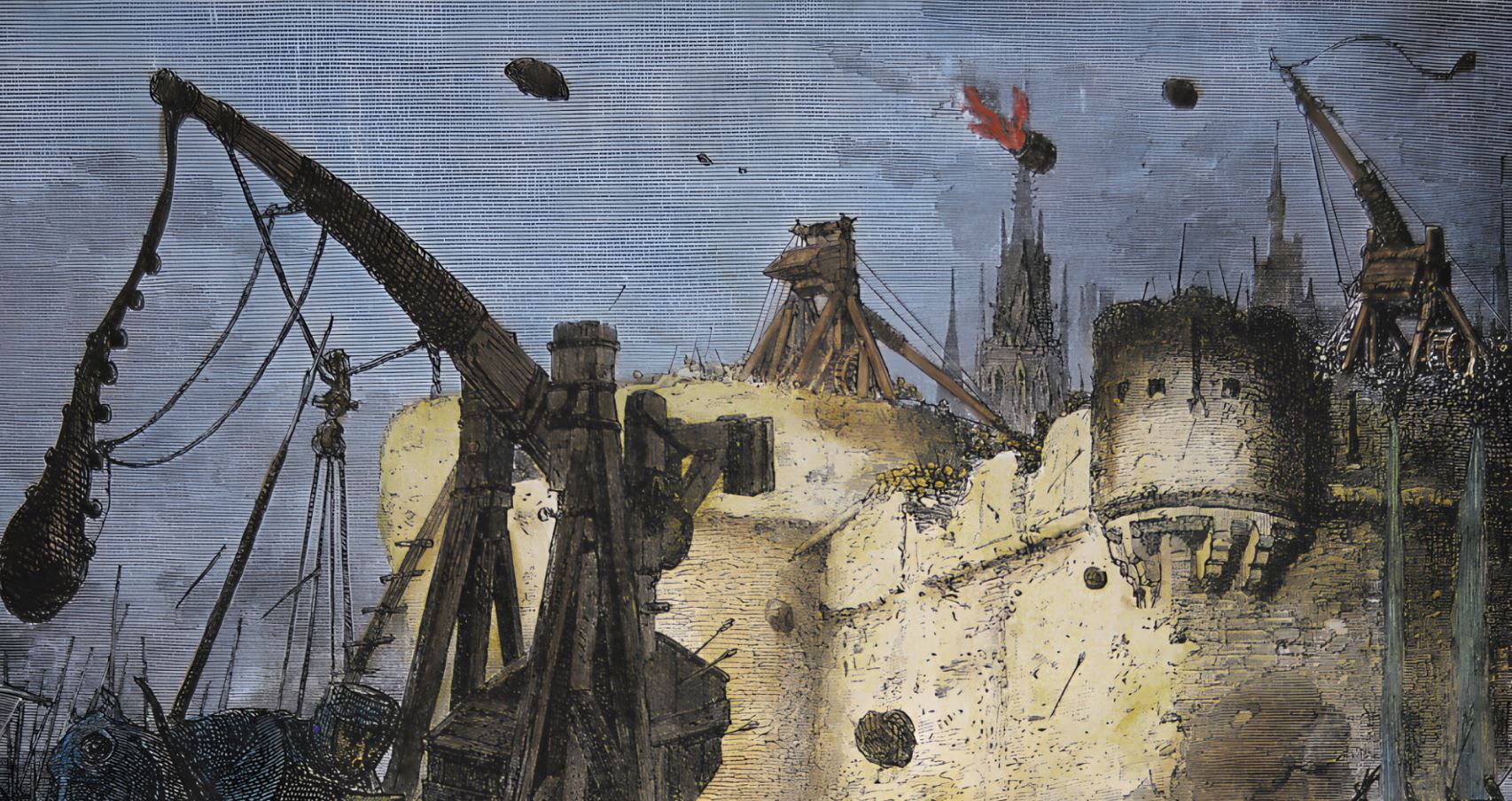
Medieval engineers turned wood, rope, and reason into unstoppable siege machines
Foundations of a Siege Camp
A siege began long before the first stone struck a parapet. Commanders walked the ground with surveyors who paced distances, measured slopes, and read the wind with ribbons tied to ash poles. Engineers selected a campsite beyond arrow range yet close enough for rapid labor, then traced trenches and berms that would creep forward in measured bites. Pioneers felled trees for palisades, gabions, and corduroy roads that kept carts from sinking. A field forge clanged from dawn to dusk, shaping nails, strap iron, and broad hinges, while coopers sealed barrels that guarded grain and water against rain and vermin. Tents stood behind a breastwork of wicker and sod, and latrines sat downwind by order instead of habit. The camp mirrored a city, with lanes, cook fires, picket lines, and a guarded market that kept barter from turning into theft. At its center lay a rectangle of order where scribes copied plans, cutters measured timber, and the master engineer kept a table of angles and ranges in a chest lined with waxed linen. Stakes marked the sites for engines and towers. Flags showed direction for hauling parties, and cairns of stone waited for polishing so that projectiles would fly true. Priests blessed tools and crews. Musicians beat steady rhythms to pace labor and to lighten shoulders. Spare rope lay soaking in troughs so that fibers would not snap when asked to bear a shock. By evening, the camp sounded like a workshop rather than an army returning to war. Workers rotated tasks to keep hands steady and minds alert. Guard captains posted hourglasses so that relief came on time. Scribes kept ledgers that tracked rope, nails, timber, and grain. Veterans taught recruits to breathe slowly before every push. Signals used horns, flags, and lanterns to stitch movement together. Rain forced adjustments, yet the plan held when leadership remained calm. Experience proved that careful preparation defeated panic and rumor. Every craft had a place, and every place depended on craft. Silence before dawn often hid the most decisive labor of the day. Maps were updated each evening after patrols measured every change.
Walls, Towers, and the Mathematics of Fear
Medieval walls were not simple fences, they were engines that turned height into time. Facings of dressed stone hid a heart of lime and rubble that swallowed shock, so blows lost fury as they spread. Flanking towers cut killing fields across the curtain and drilled fear into any approach. Gatehouses squeezed visitors along passages fitted with slots for grilles, with vents for cruel mixtures, and with holes that opened above heads. To read this architecture, engineers carried knotted cords that measured span and drop. They watched shadows crawl along merlons to gauge orientation and to predict where light would blind archers in the late hours. They studied scaffolding holes and water spouts because those small openings hinted at the pattern of the inner wall. Each measurement turned into a diagram scratched on wax with a brass stylus. From that diagram came placement of engines, because an angle could widen a target as surely as a ram could weaken a door. A tower that projected too far invited an enfilade from two sides, yet a short tower conceded blind ground to a climbing party. Even the moat spoke numbers. A narrow ditch trapped ladders close to stone where oil could reach, while a broad ditch demanded long ladders that twisted under weight. Engineers looked for mortar seams made in winter when lime cured poorly, for bulges where frost had bullied masonry, for repairs that showed haste rather than care. If a wall carried a fresh skin of plaster, that polish could hide a deeper illness. Options multiplied. One might batter, one might burn, one might sap, or one might simply wait and drink the town dry of courage. Workers rotated tasks to keep hands steady and minds alert. Guard captains posted hourglasses so that relief came on time. Scribes kept ledgers that tracked rope, nails, timber, and grain. Veterans taught recruits to breathe slowly before every push. Signals used horns, flags, and lanterns to stitch movement together. Rain forced adjustments, yet the plan held when leadership remained calm. Experience proved that careful preparation defeated panic and rumor. Every craft had a place, and every place depended on craft. Silence before dawn often hid the most decisive labor of the day. Maps were updated each evening after patrols measured every change.
Siege Towers as Moving Architecture
The siege tower answered stone with reach. Built from green timber that resisted sparks and racked with braces, it rolled forward on axles wrapped in rawhide. Carpenters added decks for archers and pavises for shelter. Wicker screens hung from outriggers to drink embers. The roof wore wet hides under a crust of clay mixed with chaff that dried hard under sun. Inside, ramps wound around a hollow spine so men could climb even while stones and bolts rattled the frame. Shields lined the inner walls to catch splinters, and buckets waited at every landing in case a spark slipped past the clay. A ram slung beneath the lowest deck pecked at masonry when the tower paused, while hooks higher up pulled at crenels to wrench loose their crests. The front wore a curtain of rawhide that reached the ground. When it dropped, a bridge came down with it, and ladders went forward to turn air into a road. Tractors hauled with hemp ropes as thick as a wrist, and teams chocked wheels with wedges when the ground heaved. The tower was not an engine alone. It was a movable wall, a stage for composite action where bow, shield, and timber made a single plan. It consumed time and timber, yet it pressed even the proudest garrison toward choice. Meet that roof with water and hooks, or pay with the wall. Workers rotated tasks to keep hands steady and minds alert. Guard captains posted hourglasses so that relief came on time. Scribes kept ledgers that tracked rope, nails, timber, and grain. Veterans taught recruits to breathe slowly before every push. Signals used horns, flags, and lanterns to stitch movement together. Rain forced adjustments, yet the plan held when leadership remained calm. Experience proved that careful preparation defeated panic and rumor. Every craft had a place, and every place depended on craft. Silence before dawn often hid the most decisive labor of the day. Maps were updated each evening after patrols measured every change.
Trebuchets and the Grammar of Gravity
The trebuchet spoke with gravity. A great box of stone and lead hung at one end of a long arm, a sling held the other end, and the pivot waited like a patient judge. Crews gathered at the ropes, haulers pulled, setters fixed the trigger, and the master eyed the breeze with a scrap of linen. At the call, the arm leapt, the sling whipped, and the stone flew with a hum that cut marrow. Good engines threw dressed limestone, rough flints, or pots filled with quickfire. They adjusted the pin by finger widths to change the angle of release, and they swapped sling lengths to match the weight of each shot. To pace firing, they worked in shifts, with tappers who knocked a measured beat on a board so hands stayed steady. A fine engine could land stones within a yard of a mark across a long field. The goal was not spectacle alone. Blows walked up a wall to shake its heart, or they skipped into a roof to start fire where water could not reach. Engineers learned to read the language of impact. A dull thud meant mass met mass. A sharp crack warned that a face stone had snapped. If dust rose like breath along a seam, the next shot would make a mouth of that seam. Such grammar of gravity turned noise into information and allowed a master to choose between terror and patience as the day wore on. Workers rotated tasks to keep hands steady and minds alert. Guard captains posted hourglasses so that relief came on time. Scribes kept ledgers that tracked rope, nails, timber, and grain. Veterans taught recruits to breathe slowly before every push. Signals used horns, flags, and lanterns to stitch movement together. Rain forced adjustments, yet the plan held when leadership remained calm. Experience proved that careful preparation defeated panic and rumor. Every craft had a place, and every place depended on craft. Silence before dawn often hid the most decisive labor of the day. Maps were updated each evening after patrols measured every change.
Mining, Sapping, and the Battle Below
The ground decided as much as the sky. Sappers drove galleries toward the base of a wall, braced the ceilings with frames, and pushed forward in stale air. Boys followed with bowls of oil to keep the dust from rising, and a candle watched the breath of the mine. When the pickheads kissed a foundation, the team built a timber crib, smeared it with fat, and fired it. When the props burned to charcoal, the roof fell and the wall above it settled into a sudden pocket. To stop that doom, defenders dug countermine shafts, set listening posts with drums of skin, and sent dogs into tunnels so growls might betray strangers beyond the dark. Sometimes both sides broke through and fought in a crawlspace where shields would not fit. The earth became a writhing corridor of breath and grit. Engineers learned the local soils by taste and touch. Clay held shape but starved lungs. Gravel slumped and drank timbers like a swamp. Chalk rang under picks and carried sound like a bell, so listeners could judge both range and direction. The battle below forced a different kind of courage, one that counted in inches rather than banners. When tunneling stalled, both sides propped galleries with green wood to resist fire, then flooded the passages to starve flames of air. The duel underfoot was a private war where victory arrived with a cracking hush, followed by the slow lean of masonry above. Workers rotated tasks to keep hands steady and minds alert. Guard captains posted hourglasses so that relief came on time. Scribes kept ledgers that tracked rope, nails, timber, and grain. Veterans taught recruits to breathe slowly before every push. Signals used horns, flags, and lanterns to stitch movement together. Rain forced adjustments, yet the plan held when leadership remained calm. Experience proved that careful preparation defeated panic and rumor. Every craft had a place, and every place depended on craft. Silence before dawn often hid the most decisive labor of the day. Maps were updated each evening after patrols measured every change.
Logistics, Fire, and the Theater of Night
Armies fed on arithmetic. Bread, salt meat, oats, and clean water mattered more than brave speeches. Livestock needed fodder that did not mold, smiths required charcoal that burned hot and steady, and carpenters begged for sound timber. Quartermasters matched supplies to weather as carefully as commanders measured courage. Night brought its own playbook. Fire pot crews lobbed clay shells filled with pitch and resin. Ladder teams ran with hooks and boards, while drummers stitched movement together across the dark. Lanterns wore cowls so light did not betray direction, and runners repeated passwords that changed with the moon. On rainless nights, slingers threw jars of lime whose dust punished eyes more surely than any blade. The besieger staged illusions as well. Men marched in circles at a distance with torches held high so the garrison counted phantom companies. Engines creaked without firing to steal sleep. Then, when the town was numb with dread, the camp fell quiet and saved strength for dawn. Sickness stalked every tent. Coughs rolled like surf when fog settled in the low ground. Surgeons boiled blades and wiped handles with vinegar. Priests muttered over wounds and over barrels of water, while cooks learned to salt meat properly and to keep flies from the broth. The rhythm of a siege lived in these domestic arts as much as in shot and flame. Victory loved order, and order began with a ration line that never failed. Workers rotated tasks to keep hands steady and minds alert. Guard captains posted hourglasses so that relief came on time. Scribes kept ledgers that tracked rope, nails, timber, and grain. Veterans taught recruits to breathe slowly before every push. Signals used horns, flags, and lanterns to stitch movement together. Rain forced adjustments, yet the plan held when leadership remained calm. Experience proved that careful preparation defeated panic and rumor. Every craft had a place, and every place depended on craft. Silence before dawn often hid the most decisive labor of the day. Maps were updated each evening after patrols measured every change.
Countermeasures Behind the Battlements
Defenders practiced invention. Behind merlons and galleries, carpenters threw out new hoardings that cantilevered above the wall so stones and cruel mixtures could fall straight down. Teams soaked spare hides and spread them over roofs. Chains stretched across approaches to foul ladders. Archers rubbed chalk lines on shields to align shots in bad light. When a tower crept near, crews dragged hurdles onto its roof to steal sparks, then poured water in a curtain that hissed and smoked. Fire brigades ran with hooks to yank burning bundles away before flame found timber beneath clay. Ram heads received kisses from sacks of wool soaked in brine so that blows lost temper. When an engine sought to range on a single spot, masons worked at night to stitch fractures with clamps and grout, then plastered the area to confuse aim by daylight. Defenders sallied in short darts to burn hurdles, cut ropes, and drag prisoners inside who might trade secrets for a cup of wine. Musicians on the wall played bright tunes to cover the sound of repair. At dawn, flags changed places to suggest fresh companies. The mind fought as cleverly as the hand. A garrison learned to hold breath during the whistle of a stone and to relax only after it broke, since flinch stole aim and wasted arrows. In that steadiness, walls gained a kind of heartbeat that matched the discipline of the camp outside. Workers rotated tasks to keep hands steady and minds alert. Guard captains posted hourglasses so that relief came on time. Scribes kept ledgers that tracked rope, nails, timber, and grain. Veterans taught recruits to breathe slowly before every push. Signals used horns, flags, and lanterns to stitch movement together. Rain forced adjustments, yet the plan held when leadership remained calm. Experience proved that careful preparation defeated panic and rumor. Every craft had a place, and every place depended on craft. Silence before dawn often hid the most decisive labor of the day. Maps were updated each evening after patrols measured every change.
Lessons Carried Beyond the Ramparts
The end of a siege rarely ended its influence. Knowledge left with the survivors and settled in mills, bridges, and workshops. Carpenters who had braced towers built barns with stronger trusses. Smiths who forged engine fittings made hinges and locks that did not fail. Surveyors who had paced firing arcs now laid causeways with grades that saved cart horses from ruin. Lords rebuilt with thicker walls and angled forms that shrugged at stones. Town councils wrote codes about cisterns, refuse, and clean streets because filth had taught hard truths during sickness. Monks copied notebooks that recorded lever ratios, pulley rigs, and simple cranes. Those books traveled farther than armies. Even the arts changed. Playwrights set stories among camps that resembled workshops, and painters drew engines with loving detail because a line of rope and a cross of timber could carry the dignity of craft. Morals shifted as well. Many who had watched hunger grow learned to tax with prudence, to store grain with care, and to respect the quiet power of logistics. In law, charters began to weigh the burden of billeting and to balance the need for defense with the cost to markets and fields. Memory kept the rest. Old men pointed to a slope and told children where stones had flown, and those children learned that calculation saves lives. The final gift of siegecraft was not ruin but method. It taught communities to plan, to measure, and to repair. It urged them to listen to earth and weather and to honor the patient clarity that turns hardship into structure.